


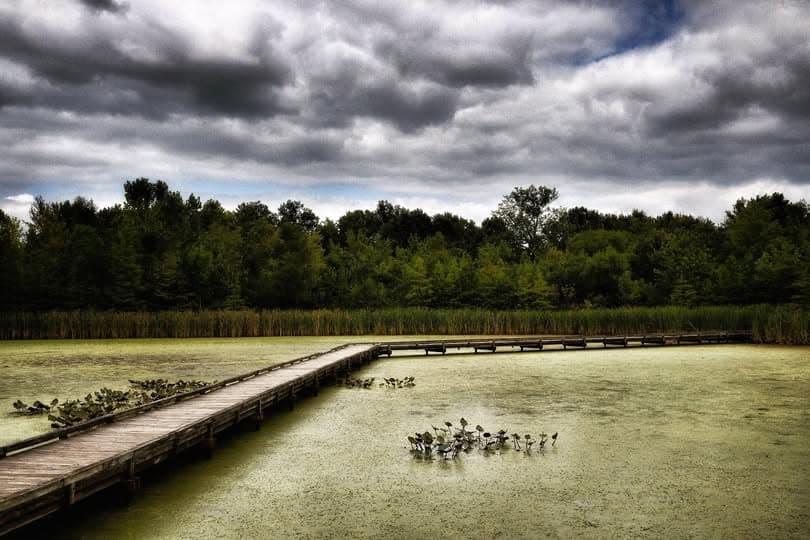
Photo Credit: Greg Ahrens
Tom Cervone, Ph.D., Nicole Cervone-Gish, M.S., and Michael Cervone, B.S.
Our Planet Earth
Author’s note: This website encourages and informs all of God’s children to act in Care for Our Common Home.
Introduction
Did you know the idea for Howell Wetlands in Evansville, Indiana, came from a 6F Conversion document for Casino Aztar to dock in the Ohio River and use a slip of land from Riverside Park? It was not much land they needed, but it was a public park, and for them to use such grounds, they needed to adequately compensate for those losses by having other properties that equaled or exceeded the loss. The term "6F conversion" refers to a provision in the Section 6(f) of the Land and Water Conservation Fund (LWCF) Act of 1965, which prohibits the conversion of land or facilities acquired or developed with LWCF grants to a non-public outdoor recreation use without the approval of the National Park Service (NPS).
The purpose of this article is: (1) to describe a 6F Conversion document, (2) give a history and show our gratitude to the many people, some of whom are no longer with us today, who were involved in the development of Howell Wetlands more than 30 years ago, and (3) recognize other lands recommended for use in Evansville. The 6F Conversion document was completed during the term of Mayor Frank McDonald II, coordinated by Mariann Kolb in the city’s contract with a local firm. Dr. Tom Cervone was the author of this document and worked with the city and the public to find such properties.
In the 1990’s, a 6F Conversion document was developed, and three parcels of land were recommended to the city. The first property was located next to Howell Slough between South Tekoppel Avenue and Broadway Avenue in the small community of Howell. Communications with Ted Grannan, then the assistant director of the Evansville Zoo, showed that it would be a great educational opportunity to share with the public. In addition, it could be managed by Wesselman Nature Society. Its original setting in 2003 and earlier was a fallow field; however, Google Earth showed a constructed Howell Wetlands in 2004.
It is our understanding that the United States Army Corps of Engineers designed and constructed Howell Wetlands which included two man-made lakes surrounded by emergent wetland and prairie ecosystems, a parking lot, a visitor center, an amphitheater, and boardwalks connected to Howell Slough. Wesselman Woods assumed management and ownership in 2009. Vascular and non-vascular plants at Howell Wetlands have been identified by Dr. Bob Mohlenbrock who taught many plant classes there with students, while other plants have been published by Keller et al. 2005.
The second property recommended was the expansion of Sunset Park on the east side of Waterworks Road, across from where the former tennis courts were located, with a proposed children’s park that was opened to the public. In 1998, it was an overgrown and thick forest of many Ailanthus altissima (tree of heaven). Steven Bohleber, then City of Evansville attorney, accompanied me on my first visit to this property, and we both thought it would be a great addition to Sunset Park.
The third property recommended was east of Green River Road along the south side of Covert Avenue and north of Angel Mounds Vectren Substation. This agricultural field in 1999 was thought to be large enough for a number of soccer fields. Using Google Earth, this field showed in 2005 a number of soccer fields in or near James Price Park.
What Can You Do?
Do you have something like Howell Wetlands near you? Such natural areas are great opportunities to learn, grow, and enjoy nature. Since the development of Howell Wetlands, much has changed. For instance, the green tree frog is a new record. Originally, its range was south of the Ohio River, but with many ways for the frog to travel northward, it is now in Howell Wetlands. Maybe it swam or floated across the Ohio River, but most think it likely hitched a ride on a boat, barge, driftwood, camper, car, truck, or train. This would make for a great children’s book on How did the green tree frog come to Indiana? For more information on this species, please see the paper Lodato, M. J., N. J. Engbrecht, S. Klueh-Mundy, and Z. Walker. 2014. The Green Treefrog, Hyla cinerea (Schneider), in Indiana. Proceedings of the Indiana Academy of Science 123:179-195.
YouTube on Howell Wetlands:
Quote: "Being in the center of suburbia, it is incredible to witness all the biodiversity at Howell Wetlands," is a quote describing the unique ecosystem. Other descriptions highlight its value as a place for both wildlife and people, with one user on Tripadvisor writing, "It provided a great moment to put my everyday life on pause and to enjoy nature in its most authentic form".
Tom Cervone, Ph.D. is the Founder of Our Planet Earth, Deacon, and ecologist. Nicole Cervone-Gish, Ed. MS. is an award-winning St. Elizabeth Anne Seton teacher at Holy Spirit. Michael Cervone, BS. is the programmer and designer of the Our Planet Earth website.
Comments may be directed to ourplanetearth.eco@gmail.com Thank you!